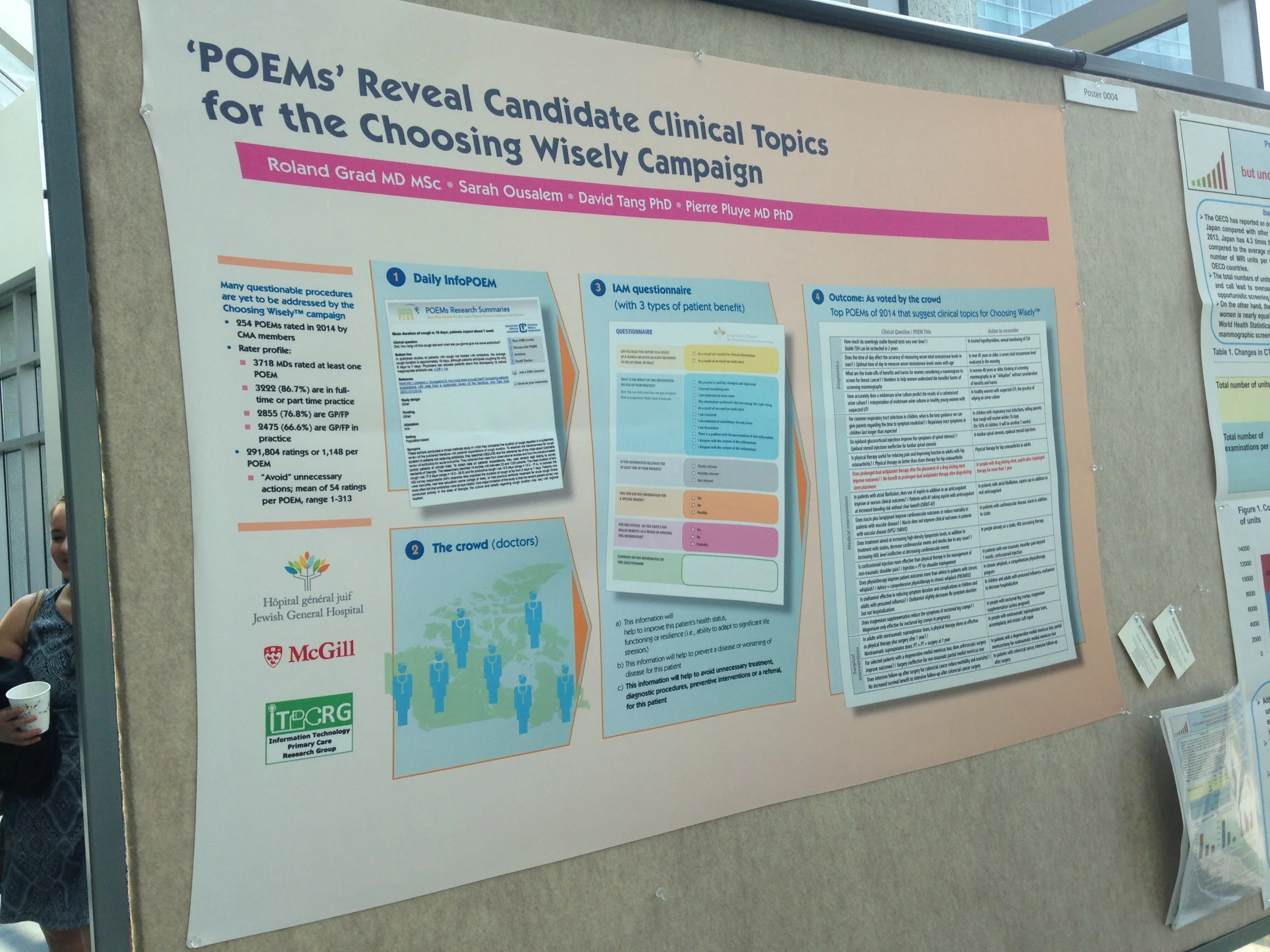
We received mixed feedback from physicians who read this POEM. Some physicians were grateful to have empiric data to help them in their discussions with patients. One wrote it is “helpful to have the actual numbers presented in such a way that I can share info with the patient when discussing mammograms and screening - always easier when there are numbers that we can look at”, and these numbers “make discussion around breast cancer more objective”. However, others wrote that even though “it is much easier to communicate this information to a patient by simply selecting the age group she falls into, and presenting the numbers for that group [...], I have not yet had a patient who didn't just simply choose the mammogram”. It seems that numbers do not tell the entire story… “because this is an emotional issue, most women we counsel opt for the regular screening”.
The importance of this topic to primary care is high, because as one CMA member wrote “the harms of false positives are seen first-hand in primary care”.
CLINICAL QUESTION: “How accurately does a midstream urine culture predict the results of a catheterized urine culture? POEM Title: Interpretation of midstream urine cultures in healthy young women with suspected UTI”
What about the practice of empirically treating suspected urinary tract infection in otherwise healthy women without relying on culture? In a diagnostic test evaluation study, midstream urine cultures with any evidence of E. coli or K. pneumoniae strongly suggested a true infection, while the presence of enterococci or group B streptococci had little predictive value. [4]
Feedback from physicians who read this POEM showed appreciation for the findings and included comments such as this one: “As a walk-in clinic doctor, urinary symptoms are a very common reason for visits. I routinely treat women on spec for these UTI's and don't send their urine for culture unless it is a complicated UTI, the patient has significant comorbidities, or the patient has recently been on antibiotics.”
The practice of empirically treating suspected urinary tract infection in otherwise healthy women without relying on culture was recommended in a recent review by Grigoryan et al. [5] Her group reviewed the optimal approach for treating acute cystitis in young healthy women and analyzed studies totalling 259 397 patients. This showed that “immediate antimicrobial therapy is recommended rather than delayed treatment or symptom management with ibuprofen alone”.
This choosing-wisely-approach to a common infection was perfectly summarized in this comment submitted by another physician: “great info [in this POEM]. Sometimes we just do too much testing”.
Conclusion
As we reflect on all this, we see that even if one test “can’t hurt”, at scale the impact can be large for publicly funded health care systems. This point has been made by others. For example, Kale et al showed how “routine” diagnostics tests cost large sums of money. [6] Primary health care faces a big challenge in reconsidering how diagnostic testing is used, to ensure better value for all.
References
1. Grad RM, Pluye P, Tang DL, Shulha M, Slawson DC, Shaughnessy AF. 'POEMs’ suggest potential clinical topics for the Choosing Wisely Campaign. Journal of the American Board of Family Medicine 2015;28:184-189. http://www.jabfm.org/content/28/2/184
2. Pecina J, Garrison GM, Bernard ME. Levothyroxine dosage is associated with stability of thyroid-stimulating hormone values. Am J Med 2014;127(3):240-245 http://www.amjmed.com/article/S0002-9343(13)01021-8/abstract
3. Welch HG, Passow HJ. Quantifying the benefits and harms of screening mammography. JAMA Intern Med 2014; Dec 30 http://archinte.jamanetwork.com/article.aspx?articleid=1792915
4. Hooton TM, Roberts PL, Cox ME, Stapleton AE. Voided midstream urine culture and acute cystitis in premenopausal women. N Engl J Med 2013;369(20):1883-1891 http://www.nejm.org/doi/full/10.1056/NEJMoa1302186
5. Grigoryan L, Trautner BW, Gupta K. Diagnosis and Management of Urinary Tract Infections in the Outpatient Setting. JAMA. 2014;312(16):1677-1684. http://jama.jamanetwork.com/article.aspx?articleid=1917443
6. Kale MS, Bishop TF, Federman AD, Keyhani S. "Top 5" lists top $5 billion. Arch Intern Med 2011;171(20):1856-1858